
Rental appliances such as refrigerators and stoves generally have a 5-year recovery period under MACRS GDS. IRS Publication 946 describes 100% bonus depreciation for qualifying property acquired and placed in service after January 19, 2025. Acquisition timing, business use, elections, and loss limits matter; a full deduction is not automatic for every purchase. Publication 527 · Publication 946
What changed under OBBBA?
OBBBA restored 100% bonus depreciation for qualifying property acquired and placed in service after January 19, 2025, with no scheduled phase-down for that property. Earlier acquisitions remain under prior-law rules; a binding contract can affect the acquisition date. See IRS Notice 2026-11.
Buying an appliance is not the same as placing it in service: it must be ready and available for its rental use. Keep both dates. Federal treatment also does not determine your state deduction.
Which Appliances Qualify as 5-Year MACRS Property
Common STR Appliances: 5-Year MACRS
5-year GDS · Eligibility depends on factsCommon rental appliances to review with your CPA include the following. Classification, expensing options, and bonus eligibility depend on the asset and how it is used:
Appliance vs. Building Component: The Key Distinction
Appliances and building systems can have different recovery periods. Removability alone is not a complete classification test. Publication 527 lists rental appliances separately from structural components; integrated HVAC and other building systems require a separate review. The table shows typical GDS treatment, subject to the property’s classification.
| Item | Classification | Recovery Period | Reason |
|---|---|---|---|
| Freestanding refrigerator | Personal property | 5 years | Removable without damage |
| Built-in refrigerator (panel-ready) | Personal property | 5 years | Still removable appliance |
| Freestanding dishwasher | Personal property | 5 years | Portable, not structural |
| Built-in dishwasher | Personal property | 5 years | Can be removed; appliance function |
| Window AC unit | Personal property | 5 years | Removable; not integrated |
| Central HVAC system | Building component | Building recovery period | Depends on residential/nonresidential classification |
| Built-in oven (range) | Personal property | 5 years | Appliance; not structural |
Bonus Depreciation vs. Section 179 for Appliances
Bonus depreciation and Section 179 can accelerate recovery of qualifying costs, but they have different eligibility rules and limits. Neither is a blanket promise that the cost will reduce this year’s tax bill:
- Bonus depreciation: Automatic (you opt out if you don't want it). Can create a net loss. Not subject to the Section 179 business-income cap; other loss limitations can still apply. Applied by asset class.
- Section 179: Elected on Form 4562. Cannot create a net loss. The 2026 maximum is $2,560,000, with phaseout beginning at $4,090,000 of qualifying property placed in service. Business-income and eligibility limits also apply. See Publication 946. Applied per asset.
Ask your CPA to evaluate bonus depreciation, Section 179 eligibility (including lessor rules), and any applicable expensing election. Passive-activity, at-risk, personal-use, and other loss limitations may affect the current-year result.
Illustration only: in the kitchen example above, $6,150 of eligible appliance basis could be deducted in the first year if 100% bonus depreciation applies and the full deduction is usable that year. The tax effect depends on your bracket and the rest of your return. Standard MACRS uses depreciation conventions, rather than five equal annual deductions.
The de minimis safe harbor may allow eligible purchases of up to $2,500 per invoice or item to be expensed without depreciation for taxpayers without an applicable financial statement. It requires consistent bookkeeping treatment and an annual election; it is not automatic. IRS requirements →
Documentation: What You Need to Keep
For every appliance you depreciate, maintain these records:
- Purchase receipt showing cost, date, and item description
- Placed-in-service date: the date the appliance was installed in the rental and available for guest use
- Photo of the appliance in the rental unit, ideally with a date stamp
- Model and serial number for high-value appliances (useful for insurance claims too)
When you launch a new STR or re-furnish an existing one, do a single walkthrough with your phone camera and photograph every appliance in place. Preserve the original photo metadata and record when the item was ready for rental use. Do not alter dates to imply earlier documentation. This creates a contemporaneous record that documents both the appliance itself and its presence in the rental unit on a specific date.
Maintenance and Repairs: Separately Deductible
Routine maintenance and repairs may be currently deductible, while betterments, restorations, or adaptations can require capitalization. A replacement part is not automatically a repair, and a new appliance may qualify for an expensing election. Publication 527 discusses repairs and improvements; have your CPA classify the cost.
Track Every Appliance in Your STR Portfolio
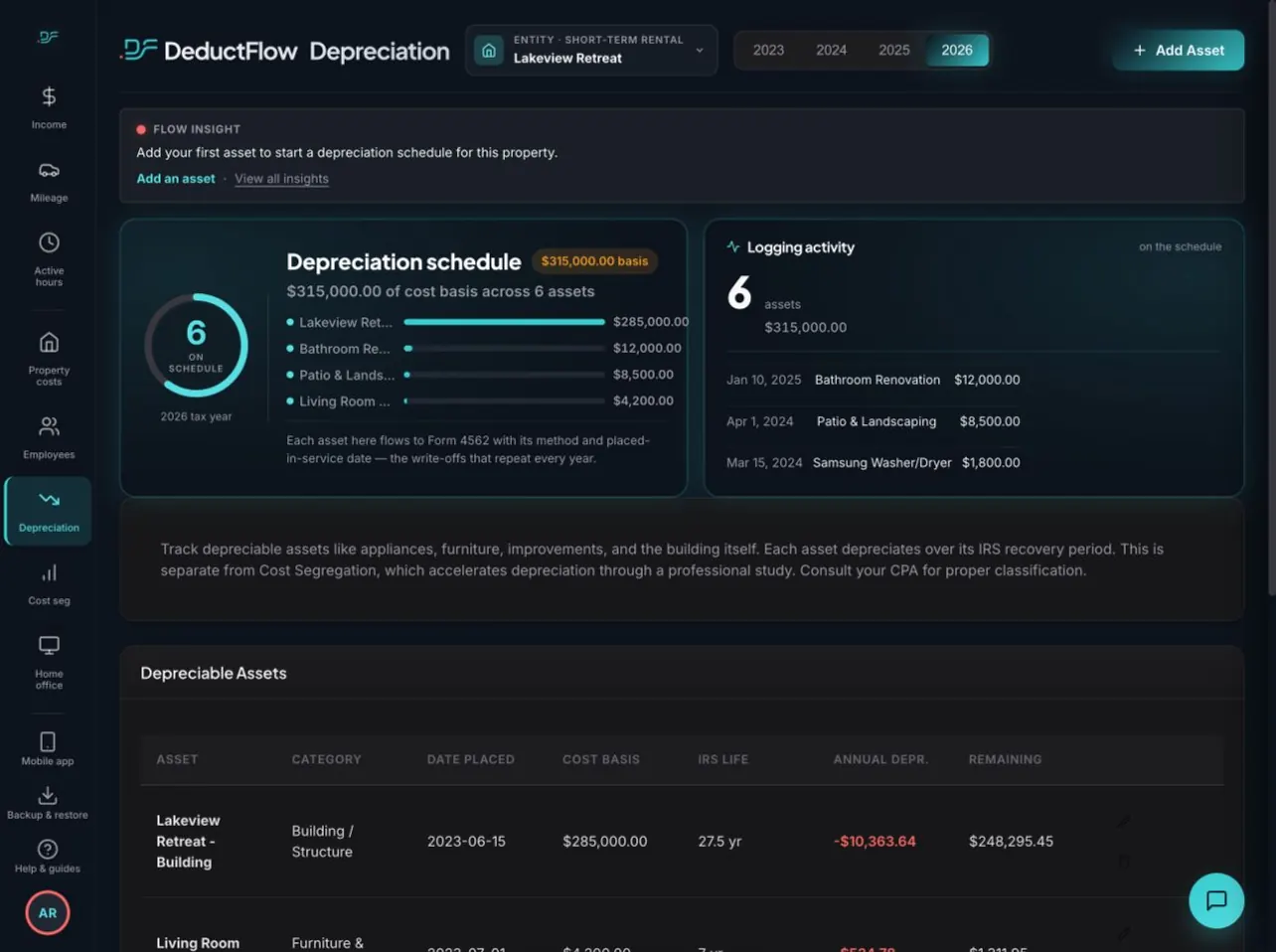
DeductFlow tracks your appliance inventory by unit, with purchase dates, placed-in-service dates, and depreciation schedules, so your CPA can review the basis and treatment with the supporting records.
Start Tracking Free →Pro from $24/month or $149/year · 7-day free trial · No credit card required
Related Reading
Disclaimer
This article is for informational purposes and does not constitute tax, legal, or financial advice. Tax rules vary based on your specific situation, filing status, entity structure, and jurisdiction. Always consult a qualified CPA or tax professional for guidance on your specific tax situation. IRS rules and thresholds are subject to change, verify current requirements at irs.gov before filing.
Frequently Asked Questions
What is the MACRS depreciation period for STR appliances?
IRS Publication 527 lists rental appliances such as stoves and refrigerators as 5-year property under GDS and 9-year property under ADS. Classification and depreciation method must be confirmed for the particular asset.
Is a built-in dishwasher treated differently than a portable dishwasher for depreciation?
A dishwasher used in a rental is generally appliance property rather than a building component. Installation alone does not settle tax classification. Review integrated systems separately, and check bonus eligibility independently of the recovery period.
Can I use Section 179 to expense STR appliances immediately?
Potentially, but not automatically. Section 179 requires qualifying purchased property used in a trade or business, and has business-use, income, dollar, and noncorporate-lessor restrictions. The 2026 maximum is $2,560,000, with phaseout beginning at $4,090,000. Ask your CPA whether the rental activity and asset qualify.
Do I need to keep receipts for STR appliances to claim depreciation?
Keep the purchase record, cost basis, acquisition date, and placed-in-service date. Retain allocation support for appliances acquired with the property, as well as business-use information and relevant depreciation elections.
Did OBBBA restore 100% bonus depreciation for rental appliances?
OBBBA restored 100% bonus depreciation for qualifying property acquired and placed in service after January 19, 2025, with no scheduled phase-down for that property. Earlier acquisitions remain under prior-law rules. A binding contract can affect the acquisition date, and other eligibility and loss limits still apply.