This is the complete guide to short-term rental tax deductions for 2026. Forty-seven deductions are available to Airbnb and VRBO hosts, organized below by category. The list applies whether you operate one cabin or a portfolio of urban units, and whether your CPA files the rental on Schedule E or as an active short-term rental business. Every deduction below includes the IRS form line, what qualifies, what does not, and the documentation you need to defend the deduction in an audit.
The key to maximizing eligible deductions is understanding what may qualify and keeping detailed records throughout the year — not scrambling to find receipts in April. Purpose-built STR tax tracking software can categorize expenses into IRS IRS expense categories as you incur them, so nothing falls through the cracks. This guide covers every major deduction category for the 2026 tax year, including recent changes from the One Big Beautiful Bill Act. Your specific eligibility depends on your circumstances — work with a CPA to determine what applies to your situation.
Need a tool to track all of this? See our ranked comparison of the best STR tax tracking tools for 2026.
Can You Write Off Airbnb Expenses?
Yes. Most ordinary and necessary expenses you incur to operate your short-term rental are deductible on your federal return. This includes everything from cleaning fees and supplies to mortgage interest, property taxes, insurance, mileage, and depreciation. The IRS allows deductions for expenses that are both common in your trade or business and helpful for earning rental income. The detailed sections below cover every major short-term rental tax deduction category, but the short answer is: if you spent it to run your STR, it is almost certainly deductible. Need the full list mapped to IRS expense categories? See our 2026 STR tax deductions checklist.
Short-Term Rental Tax Deductions 2026: What Changed This Year
The 2026 tax year brings several updates that affect STR hosts:
- Standard mileage rate: The IRS standard mileage rate for business use of a vehicle is $0.725 per mile for January–June 2026, rising to $0.76 per mile from July 1, 2026 (a rare mid-year increase). See IRS Standard Mileage Rates.
- 100% bonus depreciation restored: The One Big Beautiful Bill Act reinstated 100% first-year bonus depreciation for qualifying property acquired after January 19, 2025. This is a major change for hosts who purchased property or completed cost segregation studies.
- 1099-K threshold: The One Big Beautiful Bill Act restored the $20,000 AND 200-transaction threshold for 2025 and later years, so third-party platforms like Airbnb and VRBO only issue Form 1099-K above both marks (the $5,000 transitional threshold applied to 2024 only). Fewer hosts will receive a 1099-K — but all rental income is taxable and must be reported whether or not the form arrives.
- Standard deduction increase: The standard deduction for 2026 is $15,000 for single filers and $30,000 for married filing jointly. If your total itemized deductions (including rental property deductions) don't exceed the standard deduction, you may still benefit from active business or Schedule E deductions, which are separate from the standard vs. itemized deduction decision.
Active Business Filing vs. Schedule E: Which Form Do You File?
Before listing your deductions, you need to determine how to report your rental income. The IRS treats short-term rentals differently depending on two factors: average guest stay length and the level of services you provide.
Active Business Filing (Self-Employment Income) — If your average guest stay is 7 days or fewer and you provide "substantial services" (cleaning between guests, furnishing linens, providing concierge-type assistance), the IRS generally treats your STR as an active trade or business. You report income and expenses on the Profit and Loss schedule. This has a key advantage: if you materially participate, losses from your STR can offset your W-2 or other active income.
Schedule E (Passive Rental Income) — If average stays exceed 7 days or you provide minimal services, your rental income is generally passive and goes on Schedule E. Passive losses can only offset passive income unless you qualify as a real estate professional.
For a deeper comparison, see our active business filing vs. Schedule E guide. The distinction matters because it determines which deductions you can take and how losses are treated.
The Big Three: Mortgage Interest, Property Taxes, and Insurance
No credit card required
According to the IRS Publication 527 (Residential Rental Property), these are typically among the largest deductions available for rental property owners. If your property is used exclusively for rental purposes, the full amount of mortgage interest, property taxes, and insurance premiums may be deductible. If you also use the property personally, these expenses generally need to be allocated based on the percentage of rental use versus personal use.
Your lender provides Form 1098 each year showing how much mortgage interest you paid. Note that only the interest portion of your mortgage payment is deductible — not the principal.
Common Operating Expenses
The IRS generally allows deduction of "ordinary and necessary" expenses for rental activities. Common categories for STR owners include:
Cleaning and turnover costs — Whether you hire a cleaning crew or buy supplies yourself, these are generally considered deductible business expenses. This includes laundry services, cleaning supplies, and turnover coordination fees.
Repairs and maintenance — Fixing a leaky faucet, replacing a broken appliance, or repainting a room are typically deductible in the year they occur. The IRS distinguishes between repairs (generally deductible immediately) and improvements (which typically must be depreciated over time). See IRS Publication 527, Repairs and Improvements for details.
Utilities — Electric, gas, water, sewer, internet, and cable for your rental property. If you use the property personally part of the year, these should be prorated based on rental days.
Platform fees — The service fees Airbnb, VRBO, or Booking.com charge are generally deductible as commissions or fees.
Supplies — Towels, linens, toiletries, kitchen essentials, and other items you provide for guests are generally considered deductible supply expenses.
Professional Services
Fees paid to professionals for your STR business may be deductible, including CPA or tax preparation fees related to the rental, attorneys for rental-related legal matters, bookkeeping services, and property management software subscriptions.
Depreciation
According to the IRS Publication 946 (How to Depreciate Property), depreciation allows property owners to recover the cost of income-producing property through yearly deductions. For residential rental property, the recovery period is 27.5 years. A short-term rental is often different: when guests mostly stay under 30 days, the home is used on a transient basis, and many CPAs depreciate the building over 39 years as nonresidential real property. Use the period your CPA puts on the return. While depreciation doesn't involve an out-of-pocket cost each year, it can significantly reduce taxable rental income.
Cost Segregation and Bonus Depreciation
Cost segregation studies may allow certain property components (furniture, appliances, landscaping, cabinetry, flooring) to be reclassified from the 27.5- or 39-year building schedule into shorter recovery periods of 5, 7, or 15 years. With 100% bonus depreciation restored by the One Big Beautiful Bill Act for property acquired after January 19, 2025, qualifying components can be deducted entirely in year one. You can accelerate depreciation with a cost seg study and see your estimated first-year benefit using the free calculator.
A cost segregation study typically costs $3,000–$7,000 but can yield $50,000–$150,000+ in first-year deductions depending on property value. This strategy is most beneficial in the year you purchase the property or place it in service as an STR. Start with the Airbnb cost segregation calculator to estimate the opportunity, then use our beginner's guide to understand the process.
Discuss with your CPA whether cost segregation applies to your situation. If you decide to pursue it, DeductFlow Pro includes dedicated cost segregation tracking to organize the accelerated depreciation schedules alongside your regular expenses.
Mileage and Travel
Trips to your rental property for management purposes may be deductible. The IRS offers two methods:
- Standard mileage rate: $0.725 per mile (Jan–Jun 2026; $0.76/mile from July 1, 2026). Simpler to track — just log each trip's date, destination, purpose, and miles driven.
- Actual vehicle expenses: Track gas, insurance, maintenance, depreciation, and other vehicle costs, then apply the business-use percentage. Requires more detailed record-keeping.
Qualifying trips include drives to and from the property for inspections, cleaning supervision, supply runs, guest check-ins, maintenance, and hardware store visits. The IRS requires a contemporaneous log — notes made at or near the time of each trip, not reconstructed at year-end. Without adequate documentation, the IRS can disallow your entire mileage deduction. See our IRS mileage deduction guide for Airbnb hosts for details.
Material Participation and the 100-Hour Rule
If you file as an active business, one of the most powerful tax strategies available is material participation. When you materially participate in your STR business, any net losses can offset your W-2 wages, self-employment income, or other active income — potentially saving thousands in taxes.
The IRS defines seven material participation tests. The one most relevant to STR hosts is the 100-hour rule: you must spend more than 100 hours on your STR business during the tax year, and no other individual (including a property manager) can spend more hours than you.
Qualifying activities include:
- Guest communication and booking management
- Cleaning or supervising cleaners between guests
- Property inspections and maintenance
- Purchasing supplies
- Marketing and listing optimization
- Reviewing financials and bookkeeping
- Coordinating repairs and contractors
The IRS requires contemporaneous records — a detailed log of dates, activities, and time spent, kept throughout the year. DeductFlow Pro includes built-in active hours tracking with photo evidence and exportable time logs specifically designed for this test. See our material participation guide for the full breakdown.
Hiring Family Members
If you operate your STR as a sole proprietorship, you may be able to hire your children under 18 to help with the business. Wages paid to your children for legitimate work — cleaning, photography, social media management, supply organization — are generally deductible as a business expense. Under current IRS rules, wages paid by a sole proprietor to their child under 18 are exempt from FICA taxes (Social Security and Medicare). Each child can earn up to the standard deduction amount ($15,000 in 2026) tax-free.
This strategy requires real work performed, reasonable wages for the work done, proper documentation (time logs, job descriptions), and W-2 filing. Hiring family members is a lesser-known but powerful tax strategy — our full guide covers pay rates, documentation, and the FICA exemption rules.
Complete 2026 Short-Term Rental Tax Deductions Checklist
Here is a comprehensive reference of short-term rental tax deductions that Airbnb and VRBO hosts may be eligible to claim. Eligibility varies by situation, so consult your CPA.
| Category | Examples | IRS Line |
|---|---|---|
| Mortgage interest | Interest portion of mortgage payments (Form 1098) | Line 16 |
| Property taxes | Real estate taxes on the rental property | Line 23 |
| Insurance | Homeowners, landlord, liability, umbrella policies | Line 15 |
| Cleaning & turnover | Cleaning crews, laundry, turnover supplies | Line 11 or 17 |
| Repairs & maintenance | Plumbing, appliance repair, painting, pest control | Line 21 |
| Utilities | Electric, gas, water, sewer, internet, cable, trash | Line 25 |
| Platform fees | Airbnb service fees, VRBO commissions | Line 10 |
| Supplies | Towels, linens, toiletries, kitchen items, welcome gifts | Line 22 |
| Professional services | CPA fees, legal fees, bookkeeping, tax software | Line 17 |
| Marketing | Photography, listing optimization, paid ads, direct booking site | Line 8 |
| Vehicle / mileage | $0.725/mile (Jan–Jun 2026; $0.76 from Jul 1) or actual expenses for property-related trips | Line 9 |
| Depreciation | Building (27.5 or 39 yr), furniture (5–7 yr), cost segregation | Line 13 |
| Employee wages | Cleaners, maintenance staff, family members (W-2) | Line 26 |
| Contractor payments | Independent cleaners, handymen, landscapers (1099-NEC) | Line 11 |
| Software subscriptions | DeductFlow, PriceLabs, Hospitable, smart lock apps | Line 18 |
DeductFlow's free tier includes all 17 IRS-aligned STR expense categories so you can track every deduction in the right bucket. See how DeductFlow compares to other STR tax tracking tools →
Want a version you can print and check off as you go? Use the printable checklist version to make sure you don't miss anything at tax time.
Short-Term Rental Tax Preparation Tips for 2026
Getting your deductions right starts well before tax day. Here are four steps every host should take:
- Organize records throughout the year. Keep receipts, invoices, and bank statements organized by category as you go — don't wait until April. The IRS requires contemporaneous documentation for most deductions.
- Categorize every expense to a IRS category. Each expense belongs to a specific IRS line item. Mixing categories (or dumping everything into "miscellaneous") makes your return harder to defend and easier to audit. See the complete deductions checklist for the full mapping.
- Track mileage with a log, not memory. The IRS requires a contemporaneous mileage log. Your year-end estimate won't survive an audit. Every trip to the property, hardware store, or supply run counts.
- Export a CPA-ready package before your appointment. Bring your CPA a complete record: Profit and Loss summary, expense detail, mileage log, and active hours log. DeductFlow generates all four in a single PDF — see how it compares to other tracking tools.
The Importance of Record-Keeping
The single most important thing STR owners can do is maintain organized, detailed records of every expense. The IRS may require documentation to support deduction claims, especially in the event of an audit. Key records to maintain:
- Receipts for every business expense, digital or physical
- Mileage log with date, destination, purpose, and miles for each trip
- Active hours log with date, activity, and duration for material participation
- Income documentation from Airbnb (1099-K), VRBO, and direct bookings
- Depreciation schedules including cost segregation studies
- Bank and credit card statements supporting expense claims
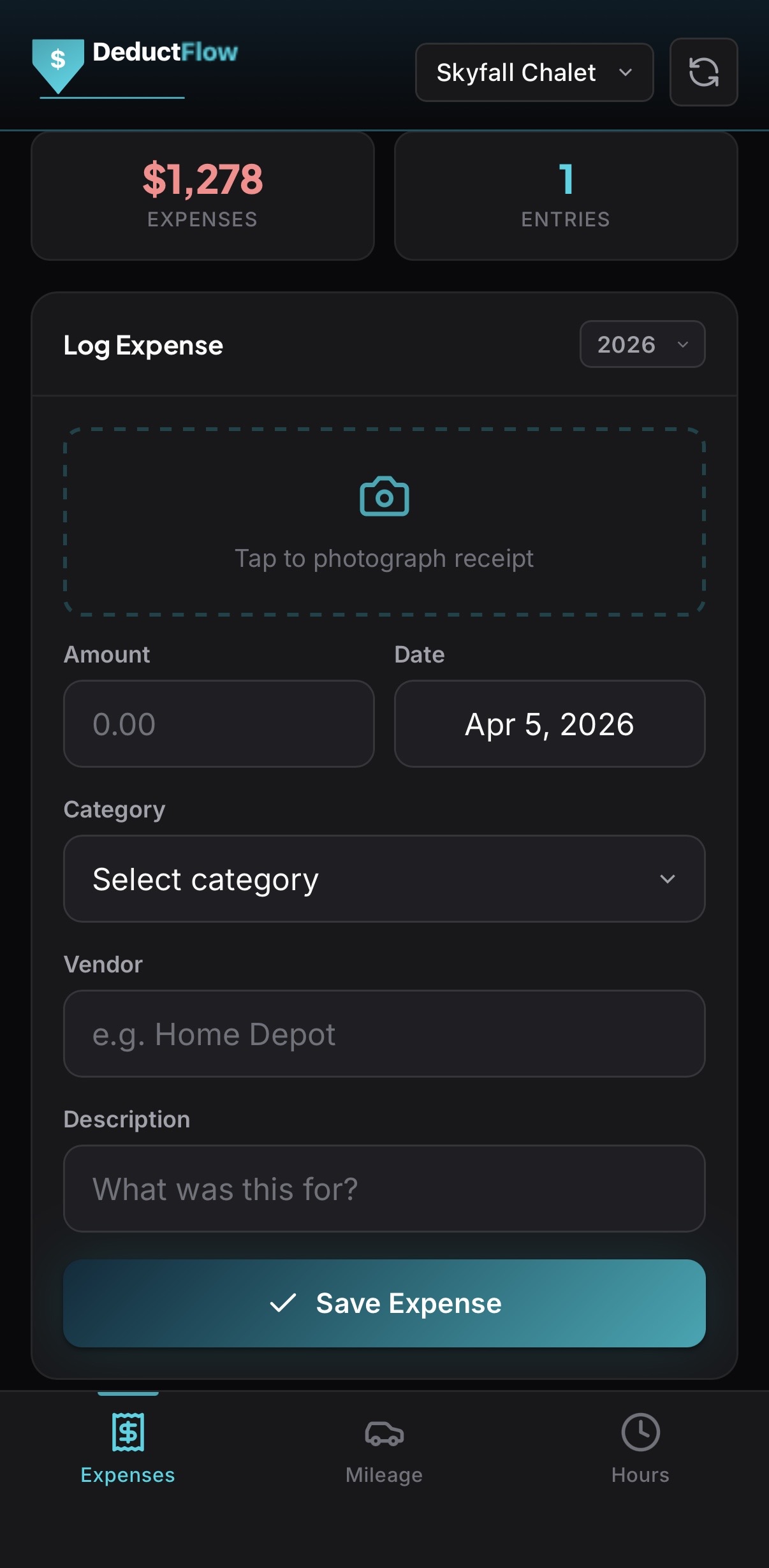
DeductFlow is designed to help Airbnb and VRBO hosts organize all of this in one place — expenses categorized by IRS category, mileage logs, active hours tracking, and CPA-ready PDF exports — so that when it's time to meet with your CPA, everything is ready. The free tier covers expense tracking and a P&L dashboard. Start free →
Best Tax Software for Short-Term Rental Hosts 2026
Tracking 17 short-term rental tax deduction categories, mileage, material participation hours, and depreciation schedules by hand is a recipe for missed write-offs. The best tax software for STR hosts in 2026 does three things: organizes expenses into IRS expense categories automatically, tracks the tax organization details that generic tools miss (like the 100-hour material participation threshold), and produces a single document your CPA can work from at tax time.
Most general-purpose accounting tools weren't designed for short-term rentals. QuickBooks doesn't track active hours. Stessa is built for Schedule E landlords. Spreadsheets can't generate CPA-ready reports. Purpose-built STR tax tracking software fills the gap — handling the categories, rules, and documentation that matter specifically to hosts filing taxes.
DeductFlow is built for exactly this: all 17 STR expense categories, IRS-compliant mileage logging, material participation hour tracking with photo evidence, cost segregation document management, and one-click CPA-ready PDF export. The free tier covers expense tracking and a P&L dashboard. Pro unlocks unlimited properties, mileage, active hours, and the PDF export. See the full comparison of STR tax tracking tools →