Round Trip vs One-Way Mileage for STR Deductions
No credit card required
The IRS measures actual miles driven for business purposes. If a property visit qualifies, both the drive out and the drive back count, and if you make multiple stops on a business circuit, you log each leg separately. There's no "round-trip only" rule; it's all about whether each mile was driven for business. One big caveat for trips that start at home: IRS Publication 527 treats travel between your home and a rental as commuting unless your home is your principal place of business, so confirm with your CPA which of your trips qualify.
The Core Rule: Actual Miles Driven
Under IRC §162(a) and the §274(d) substantiation rules, your mileage deduction is based on actual miles driven for business. The IRS doesn't care whether your route is a round-trip, one-way, or a circuit with multiple stops — they care whether each mile had a legitimate business purpose and whether you have records to prove it.
This means, for logging purposes (whether the home legs are deductible is the commuting question above):
- Home → STR (15 miles) + STR → Home (15 miles) = 30 miles to log
- Home → STR (15 miles) → Supply store (3 miles) → Home (18 miles) = 36 miles to log
- STR A → STR B (10 miles) = 10 miles to log (no need to return to start)
When you make a multi-stop business trip, log each leg with its own origin, destination, and purpose. It takes an extra 30 seconds in your mileage app but ensures you capture every deductible mile and have documentation the IRS expects for each segment.
Common Trip Scenarios and How to Log Them
Scenario 1: Simple Round-Trip Property Visit
You drive from home to your STR (20 miles) and back home (20 miles).
- Log: Home → STR Property — 20 miles — "Post-checkout inspection"
- Log: STR Property → Home — 20 miles — "Return from property inspection"
- Total logged: 40 miles (deductible only if trips from home qualify; see above)
Scenario 2: Property Visit + Supply Run
Home (0) → STR (20 miles) → Home Depot (5 miles) → Home (25 miles)
- Log Leg 1: Home → STR — 20 miles — "Contractor meeting, HVAC service"
- Log Leg 2: STR → Home Depot — 5 miles — "Pickup replacement cabinet hardware"
- Log Leg 3: Home Depot → Home — 25 miles — "Return from supply run and property visit"
- Total logged: 50 miles (the home legs are subject to the commuting rule)
Scenario 3: One-Way Trip (No Return to Start)
You leave from work (W-2 job) → STR (10 miles) → friend's house for dinner (3 miles personal)
- Log Leg 1: Office → STR — 10 miles — "Pre-arrival walkthrough for guests arriving tomorrow"
- Log Leg 2: STR → Friend's house — NOT deductible (personal purpose)
- Total deductible: 10 miles
No credit card required
The Common Mistake: Only Logging One-Way
A surprisingly common error among STR hosts: only logging the outbound trip (home to property) and forgetting the return leg. If the visit qualifies, both legs count, so logging one direction cuts your mileage in half.
| Scenario | Miles Logged | Annual Deduction (50 trips) |
|---|---|---|
| Only one-way (incorrect) | 15 mi/trip | $543.75 |
| Full round-trip (correct) | 30 mi/trip | $1,087.50 |
The difference is $543.75 per year from this one error alone. For the full guide on capturing all your STR mileage, see our complete mileage deduction guide. For the log format required by the IRS, see our mileage log requirements guide.
Use a mileage tracker that captures both the outbound and return legs of every trip. You'll never forget a return trip, and your log will be contemporaneous and complete by default.
Prove it.
Capture Every Mile — Both Ways
DeductFlow has round trip built in — tick one box when you log a trip and the return leg is added automatically, so you never claim only half a trip again. Every mile is valued at the 2026 IRS standard mileage rate and ready for your tax return.
Start Free →Pro from $24/month or $149/year · 7-day free trial · No credit card required
Related Reading
No credit card required
Disclaimer
This article is for informational purposes and does not constitute tax, legal, or financial advice. Tax rules vary based on your specific situation, filing status, entity structure, and jurisdiction. Always consult a qualified CPA or tax professional for guidance on your specific tax situation. IRS rules and thresholds are subject to change — verify current requirements at irs.gov before filing.
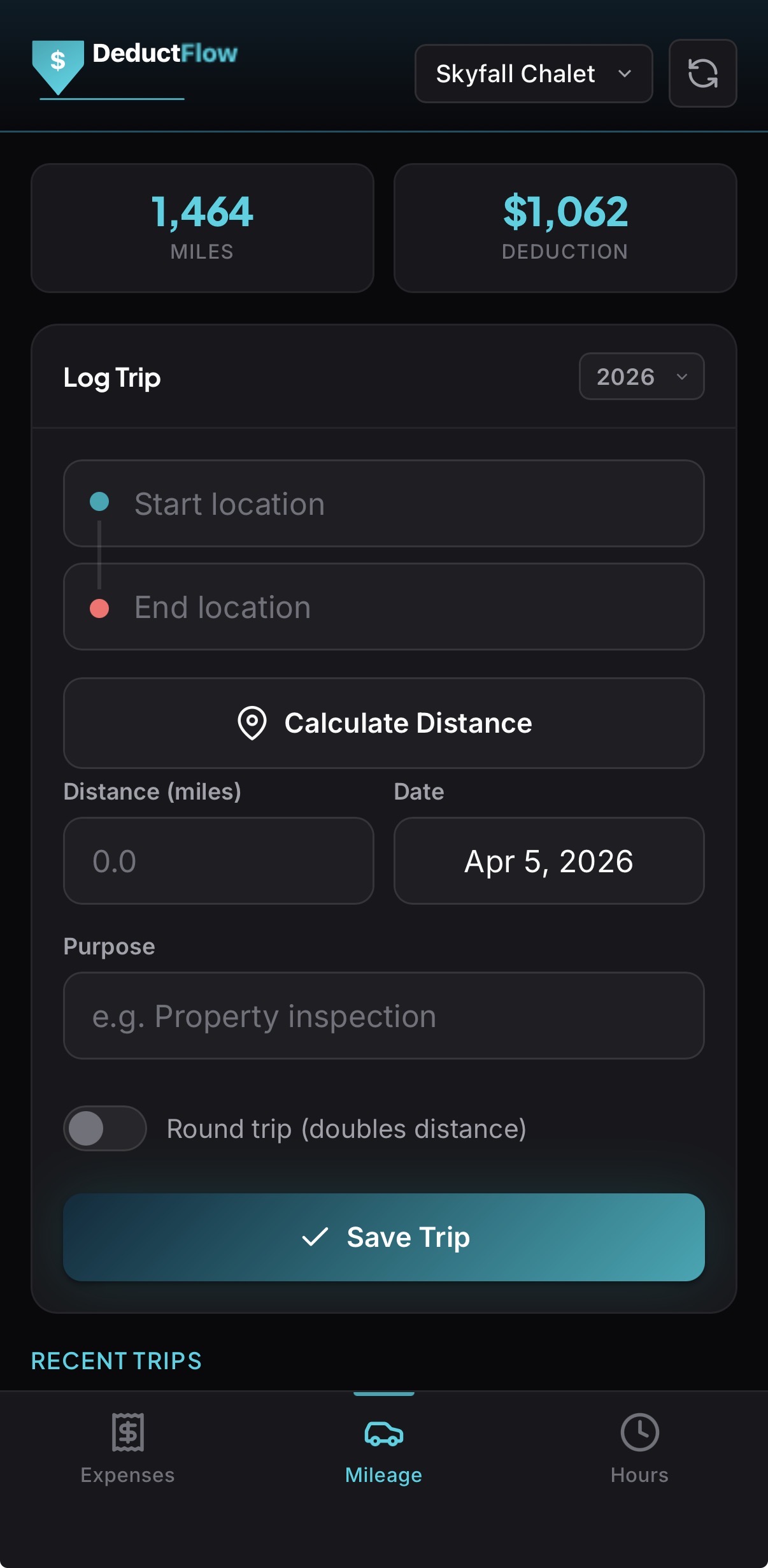
Log the full round trip automatically.
Tick one box when you log a trip and DeductFlow adds the return leg, values every mile at the current IRS rate, and keeps the log the IRS actually asks for.
Free to start · Pro is $24/month or $149/year · Comparing tools? Start with the Airbnb tax software guide.
Frequently Asked Questions
Do I deduct round-trip or one-way mileage for STR property visits?
Mileage is based on actual miles driven, so a qualifying round trip counts both ways. If you make multiple stops, you log each leg separately, regardless of whether you end at your starting point. For trips that start at home, IRS Publication 527 treats travel between your home and a rental as commuting unless your home is your principal place of business, so decide with your CPA which of your trips qualify.
Can I deduct miles for the return trip from my STR back home?
Yes — if your outbound trip (home to STR) is a deductible business trip, the return trip (STR back to home) is also deductible as part of the same business journey. You deduct all miles from the beginning to the end of the business trip, including the return leg.
What if I don't return directly home after visiting my STR?
Log each leg separately. If you go from home to STR, then STR to supply store, then supply store back home, log three legs. Legs that connect business locations may be deductible; legs to or from home are subject to the commuting rule. Miles driven to a personal destination after your last business stop are not deductible.