Short-Term Rental Tax Deductions Checklist 2026: 50 Write-Offs for Airbnb & VRBO Hosts
No credit card required
This is the short-term rental tax deductions checklist for 2026. Fifty write-offs, organized by category, in the order your CPA needs them. Download the free PDF at the end of the page and bring it to your tax appointment. Every item on the list is a legitimate short-term rental tax deduction backed by IRS guidance.
Who This Checklist Is For
This guide is specifically for STR hosts who file Profit and Loss, meaning you materially participate in managing your rental and the IRS treats it as an active business, not a passive investment. If you are filing Schedule E, many of the same deductions apply, but the form and rules differ.
Not sure which schedule you should be filing? The short version: if your average guest stay is 7 days or fewer and you provide substantial services (cleaning between guests, concierge, supplies), the IRS generally considers this a business. If you meet the material participation test (most commonly: 100+ hours of personal involvement per year, and more than anyone else), you file as an active business. When in doubt, ask your CPA. Getting this classification right matters.
The 2026 Mileage Rate Update
Before we get into the full checklist, one important change: the IRS standard mileage rate for 2026 is $0.725 per mile (72.5 cents) for trips from January 1 through June 30, 2026 — up from $0.70 in 2025 — and the IRS raised it mid-year to $0.76 per mile for trips from July 1, 2026 onward. If you're filing your 2025 return now, use $0.70/mile. For 2026 trips, apply the rate that was in effect on the date of each trip when you file next year.
Mileage for trips to manage or maintain a rental may be deductible at those rates. IRS Publication 527 treats travel between your home and a rental as commuting unless your home is your principal place of business, so confirm with your CPA which of your trips qualify.
The Complete Deduction Checklist
No credit card required
Here's every deduction category, organized by the IRS category where it gets reported. Bookmark this — you'll want it at tax time.
Advertising & Marketing
IRS Line 8Anything you spend to attract guests and promote your listing falls here. This goes beyond platform fees — think about all the ways you market your property.
Car & Travel Expenses (Mileage)
IRS Line 9Business-related trips may be deductible, but IRS Publication 527 treats travel between your home and a rental as commuting unless your home is your principal place of business, so decide with your CPA which trips qualify. You can choose the standard mileage rate ($0.70/mi for 2025; $0.725/mi Jan–Jun 2026 and $0.76/mi Jul–Dec 2026) or track actual vehicle expenses — but you must choose one method and stick with it for that vehicle.
The IRS requires you to log the date, destination, business purpose, and miles driven for every trip. "I drove to the property a lot" won't survive an audit. Log each trip when it happens — not at tax time from memory.
Track Every Mile Automatically
DeductFlow's mobile app logs the date, destination, purpose, and distance for every trip — exactly what the IRS requires. Stop losing mileage deductions to bad record-keeping.
Start Tracking Free →7-day free trial · No credit card required
Commissions & Platform Fees
IRS Line 10Every fee that booking platforms charge you is a business expense. This is often one of the largest deduction categories for STR hosts, and platforms report it on your 1099-K.
Contract Labor
IRS Line 11Any independent contractors you pay more than $2,000 in a year need a 1099-NEC (the threshold for payments made after December 31, 2025; it was $600 for 2025-and-earlier payments), and every dollar is deductible. This is separate from W-2 wages (which go on Line 26).
Insurance
IRS Line 15Your STR insurance policy is fully deductible as a business expense. Standard homeowners insurance typically doesn't cover rental activity, so most hosts carry a specialized policy.
Mortgage Interest
IRS Line 16aIf you have a mortgage on your STR property and it's used exclusively for rental, 100% of the interest is deductible. If you also use the property personally, you'll need to prorate based on rental vs. personal days. Your lender sends Form 1098 with the annual interest amount.
Legal & Professional Services
IRS Line 17Every professional you hire to support your STR business is deductible. This includes the software tools you use to run the business.
Your DeductFlow subscription — or any tax tracking software — is itself a deductible business expense. Your tax tracking tools are a write-off on Line 18.
Repairs & Maintenance
IRS Line 21Repairs that restore your property to its original condition are immediately deductible. Improvements that add value or extend the property's life must be depreciated instead. The distinction matters — a broken dishwasher repair is an expense; a kitchen remodel is a capital improvement.
Supplies & Furnishings
IRS Line 22Guest-facing supplies and furnishings under $2,500 per item can generally be expensed immediately under the IRS de minimis safe harbor election. Items over $2,500 must be depreciated.
Taxes & Licenses
IRS Line 23Property taxes on your STR are deductible as a business expense (separate from the SALT deduction on your personal return). Business licenses and occupancy tax obligations go here too.
Utilities
IRS Line 25All utility costs for your STR property are deductible. If you also use the property personally, prorate based on rental vs. personal use days.
Wages
IRS Line 26W-2 employee wages — including family members you hire — are deductible. If you hire your children under 18 and you're a sole proprietor, their wages are exempt from FICA taxes, making this a powerful tax strategy.
Other Expenses
IRS Line 27aThe catch-all for legitimate business expenses that don't fit neatly into other categories. You'll list these on a separate statement attached to your return.
Depreciation & Cost Segregation
IRS Line 13Your building (not the land) depreciates over 27.5 years as residential rental property, or 39 years if it is classed as nonresidential, which many CPAs do for STRs rented mostly to short-stay guests. Use the period your CPA puts on the return. But a cost segregation study can reclassify components of your property into shorter depreciation schedules (5, 7, or 15 years), dramatically accelerating your deductions in the early years. Use the cost segregation calculator for STR owners to estimate the savings before you talk with your CPA.
Capital improvements over $2,500 — new appliances, renovations, roof, HVAC systems — get depreciated rather than expensed immediately. The MACRS (Modified Accelerated Cost Recovery System) determines the schedule.
Cost segregation is the single highest-value tax strategy for STR hosts with properties valued above $300K. The study typically costs $3,000–$8,000 but can generate $50,000–$200,000 in first-year accelerated depreciation. If you haven't done one, talk to your CPA about whether it makes sense for your property. Read our full cost segregation guide with a real STR example →
What This Adds Up To
Let's put real numbers on it. A typical Colorado mountain STR generating $40,000–$60,000 in gross rental income might have deductions that look like this:
| Category | Typical Range |
|---|---|
| Mortgage Interest | $8,000 – $25,000 |
| Property Taxes & HOA | $3,000 – $8,000 |
| Cleaning & Turnover | $4,000 – $10,000 |
| Utilities | $3,000 – $6,000 |
| Insurance | $1,500 – $3,500 |
| Platform Fees | $1,200 – $3,000 |
| Repairs & Maintenance | $1,000 – $5,000 |
| Supplies & Furnishings | $800 – $3,000 |
| Mileage | $1,000 – $3,000 |
| Professional Services | $500 – $2,000 |
| Marketing | $300 – $1,500 |
| Depreciation (standard) | $10,000 – $15,000 |
| Total Potential Deductions | $34,300 – $85,000 |
At a 24% tax bracket (plus 15.3% self-employment tax on active rental income), every $1,000 in captured deductions saves you $361 to $393 in taxes. The difference between tracking systematically and tracking loosely? Hosts who use structured systems typically capture 20 to 30% more deductions than those working from memory and bank statements.
The 5 Deductions Most Hosts Miss
Based on what I've seen from my own taxes and conversations with CPAs who specialize in STR:
1. Mileage. This is the number-one missed deduction. Hosts drive to their property constantly but almost never log individual trips. At $0.725/mile for first-half 2026 (and $0.76/mile from July 1), even moderate driving adds up fast. See our complete IRS mileage deduction guide for tracking requirements.
2. Supply runs and small purchases. The $15 pack of batteries, the $40 welcome basket restock, the $25 cleaning supplies at Target. Individually small, collectively they can total $1,000–$3,000/year.
3. Professional services and software. Many hosts don't realize their CPA fees, bookkeeping tools, pricing software, and tax tracking subscriptions are all deductible.
4. Home office deduction. If you manage your STR from a dedicated space in your home, the simplified home office deduction ($5/sq ft, up to 300 sq ft = $1,500 max) is available.
5. Material participation hours. Not a deduction per se, but if you don't track your active hours, you can't prove material participation, which means you might be filing Schedule E instead of as an active business, losing the ability to offset W-2 income with rental losses.
Prove it.
Stop Tracking in Spreadsheets. Get in the Flow.
DeductFlow tracks every deduction on this checklist: expenses by category, mileage with dates and purpose, platform income, active hours, and cost segregation. Then it exports a clean tax summary for your CPA.
Start Tracking Free →7-day free trial · No credit card required
How to Use This Checklist
Right now (if you're filing your 2025 return): Walk through each category above and check whether you've captured those expenses. Pull bank and credit card statements from 2025. Check for mileage you forgot to log. Make sure your CPA has everything categorized correctly.
Going forward (for 2026): Set up a tracking system now — whether it's DeductFlow, a spreadsheet, or even a dedicated folder in your phone's notes app. The best system is the one you'll actually use. Log expenses when they happen, not at year-end. Take photos of receipts the day you get them. Log mileage after every trip to your property.
The hosts who pay the least tax aren't the ones with the most creative accountants. They're the ones with the best records. For an even deeper dive into every deduction category, see our Short-Term Rental Tax Deductions 2026: The Complete Guide →.
We put together a one-page printable version of this checklist with checkboxes for every deduction category, mapped to IRS expense categories. Pin it above your desk or share it with your CPA. Get the free PDF checklist →
Related Reading
- Airbnb Tax Deductions 2026: Every Deduction STR Hosts Can Claim →
- Are Airbnb Cleaning Fees Tax Deductible? →
- IRS Mileage Deduction for Airbnb Hosts →
- Can You Reconstruct a Mileage Log After the Fact? Yes →
- Airbnb 1099-K Reporting 2026: What Hosts Must Do →
- Why Your Airbnb 1099-K Doesn't Match Your Bank Deposits (Free Worksheet) →
- Short-Term Rental Depreciation Guide 2026 →
- Cost Segregation for STRs: Save $10K-$100K in Year One →
No credit card required
Disclaimer
This checklist is for informational purposes and does not constitute tax, legal, or financial advice. Tax rules vary based on your specific situation, filing status, entity structure, and jurisdiction. Always consult a qualified CPA or tax professional for guidance on your specific tax situation. IRS mileage rates and deduction rules are subject to change — verify current rates at irs.gov before filing.
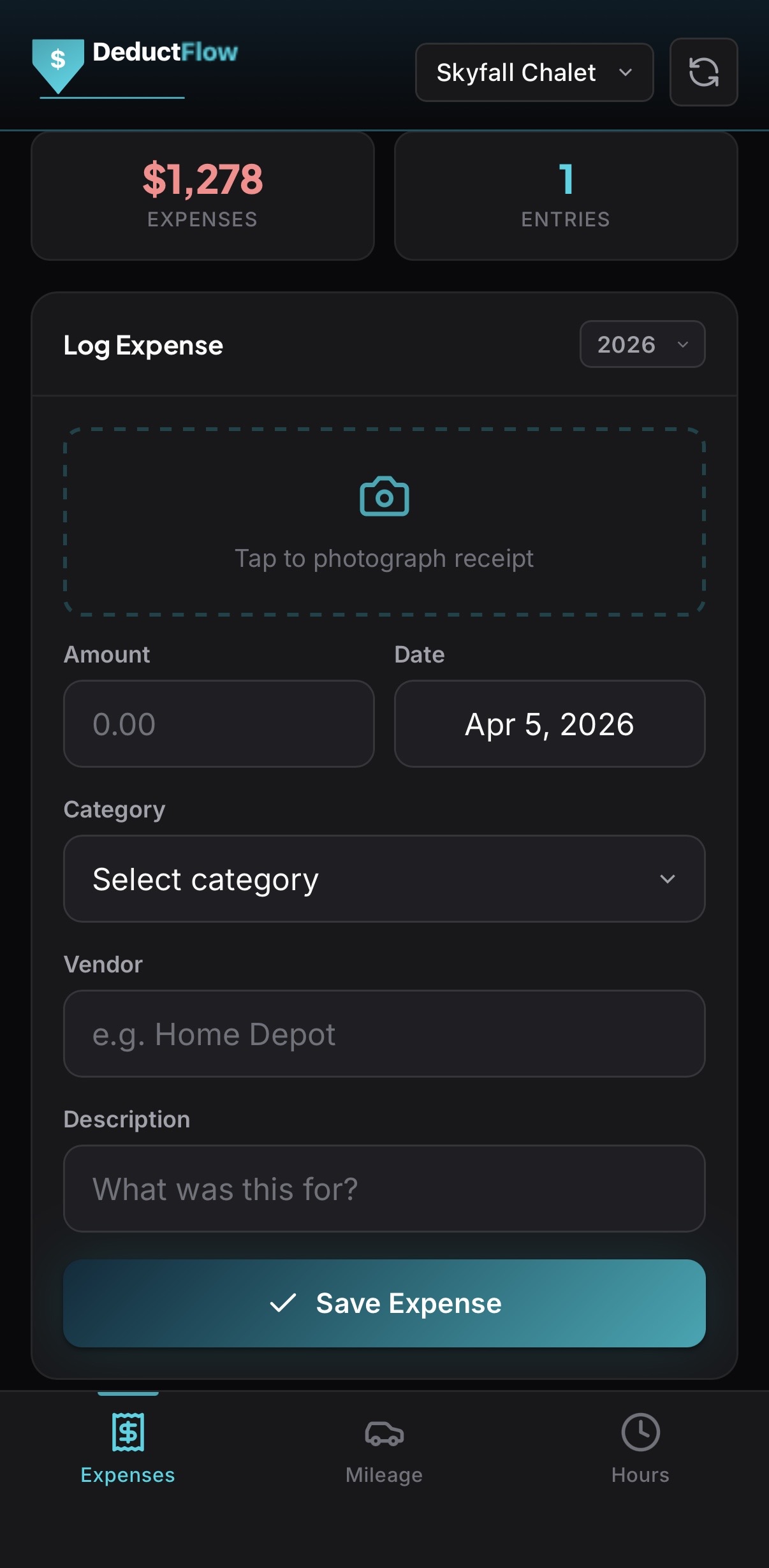
Turn this checklist into a system.
A checklist you read in July is forgotten by January. Track each line in DeductFlow as it happens and the checklist checks itself — receipts attached, categories mapped to your Schedule E.
Free to start · Pro is $24/month or $149/year · Comparing tools? Start with the Airbnb tax software guide.
Frequently Asked Questions
What are the tax return deductions for short-term rental hosts in 2026?
Short-term rental tax deductions for STR hosts span 17 IRS categories: advertising (Line 8), car and truck expenses at $0.725/mile Jan–Jun 2026 and $0.76/mile Jul–Dec 2026 (Line 9), commissions and platform fees (Line 10), contract labor (Line 11), depreciation on a 27.5- or 39-year schedule (Line 13), insurance (Line 15), mortgage interest (Line 16a), legal and professional services (Line 17), office expenses (Line 18), rent on vehicles/equipment (Line 20a), repairs and maintenance (Line 21), supplies (Line 22), taxes and licenses (Line 23), travel (Line 24a), utilities (Line 25), wages (Line 26), and other expenses (Line 27).
How many tax deduction categories are there for Airbnb hosts?
The IRS tax form for active rental businesses has 17 expense categories that apply to short-term rental hosts. Most hosts only track 7 or 8 of these, missing deductions in categories like mileage, platform fees, depreciation, licenses and permits, marketing, professional services, and cost segregation. DeductFlow includes all 17 IRS categories pre-built so every deduction is captured and mapped to the correct IRS category.
What is the IRS mileage rate for STR hosts in 2026?
The IRS standard mileage rate for 2026 is $0.725 per mile for trips from January 1 through June 30, 2026, and $0.76 per mile for trips from July 1, 2026 onward. Mileage for trips to manage or maintain a rental, such as cleaning supervision, supply runs, guest check-ins, maintenance, inspections, and hardware store visits, may be deductible. IRS Publication 527 treats travel between your home and a rental as commuting unless your home is your principal place of business, so confirm with your CPA which of your trips qualify. The IRS requires a contemporaneous mileage log with date, destination, business purpose, and miles driven for each trip.
Are Airbnb cleaning fees tax deductible?
Yes. Cleaning fees paid to turnover crews, laundry services, and cleaning supplies are generally 100% deductible as business expenses. They are reported on IRS Line 11 (Contract labor) if you pay a cleaning crew, or Line 17 (Other expenses) if you buy supplies. If you pay any single cleaner more than the 1099-NEC threshold in a year ($2,000 for payments made after December 31, 2025; $600 for 2025-and-earlier payments), you must issue them a 1099-NEC.
How do I track Airbnb expenses for taxes?
Track expenses throughout the year using categories that map to IRS expense categories: advertising, commissions, insurance, mortgage interest, repairs, supplies, taxes, utilities, wages, and depreciation. Keep receipts for every expense, log mileage for property-related trips, and track active participation hours. Tools like DeductFlow organize expenses by IRS category and generate CPA-ready exports.
What is the IRS mileage rate for 2026?
The IRS standard mileage rate for business use of a vehicle is $0.725 per mile for January 1 through June 30, 2026, and $0.76 per mile from July 1, 2026 onward. Mileage for trips to manage or maintain a rental, such as inspections, cleaning supervision, supply runs, maintenance, and guest check-ins, may be deductible. IRS Publication 527 treats travel between your home and a rental as commuting unless your home is your principal place of business, so confirm with your CPA which of your trips qualify. The IRS requires a contemporaneous log with the date, destination, business purpose, and miles for each trip.