In Hairston v. Commissioner, the taxpayers brought calendars showing as many as 932 hours of rental real estate work. They still lost the deduction. The number was large, but the Tax Court found the hours attributed to one spouse inflated by at least 150 hours, “most likely more.” Without enough credible hours for either spouse to meet the real estate professional test, the court disallowed a $27,488 rental loss.
The lesson is not that calendars fail. It is not that spreadsheets fail. It is not even that a record created after the work automatically fails. The lesson is that a time total is only as persuasive as the activities, durations, people and supporting facts underneath it.
For rental owners, that makes documentation quality a year-round operating issue—not an April formatting exercise. DeductFlow helps keep hours, activity photos, mileage, expenses, receipts, property records and depreciation information connected while the facts are still fresh, then packages those records for tax-professional review.
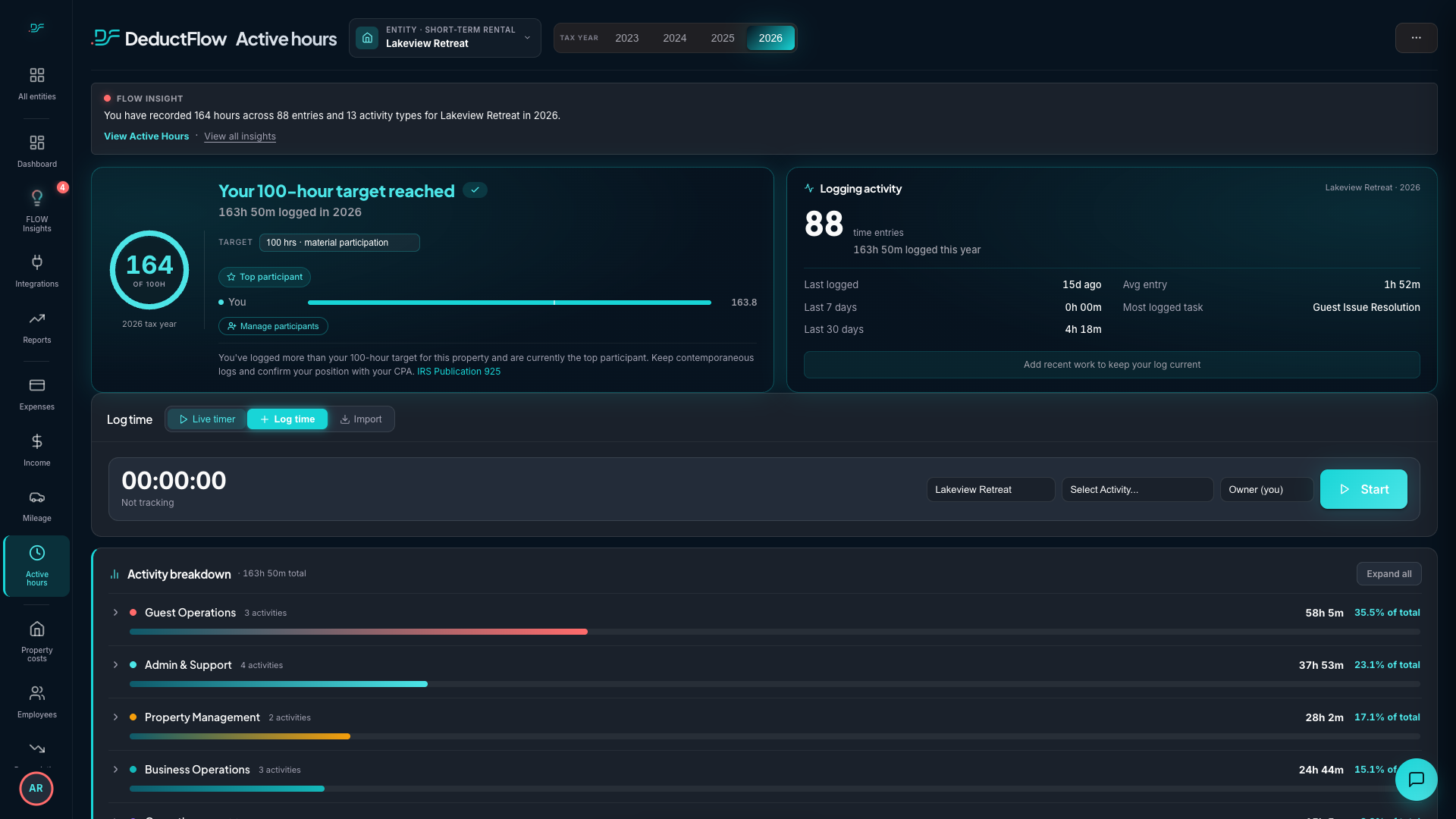
The total matters. The record underneath it matters more.
Record active hours as the work happens, see progress by participant and activity, then connect those entries with photos, expenses, receipts and mileage for tax-professional review.
Free to start · Pro is $24/month or $149/year · DeductFlow organizes records; it does not determine tax eligibility.
The case in 60 seconds
- Case: Ronnie Hairston and Gloria Cruz Hairston v. Commissioner, T.C. Memo. 2019-104.
- Tax year: 2014.
- Claim: A $27,488 rental real estate loss against ordinary income.
- Records: Two property calendars with 360 entries and no more than 932 total recorded hours.
- Holding: Neither spouse proved more than 750 hours of qualifying real property services, so the loss remained passive and was disallowed for the year.
- Penalty: The IRS conceded the $1,468 accuracy-related penalty before trial.
7-day Pro trial · No credit card required
What the Hairstons Had to Prove
The Hairstons owned two adjacent long-term rental houses in Maryland. One spouse worked full time for the Department of Homeland Security and handled much of the bookkeeping and leasing work. The other was retired and handled upkeep, contractors and rent collection.
Because their adjusted gross income was above the phaseout range for the special rental real estate allowance, they sought to treat the loss as nonpassive through real estate professional status. Under Section 469, one spouse had to independently perform more than 750 hours of services in real property trades or businesses in which that spouse materially participated. The spouses could not combine their hours to reach 750.
The calendars did not identify which spouse performed each entry. At trial, the taxpayers attributed activities between them. Even under the taxpayers' best-case allocation, the husband reached only 781 claimed hours—a margin of 31 hours above the statutory threshold.
Why the Court Did Not Trust the 781-Hour Total
The court did not reject the calendars because of their format. It examined what the entries said and whether the durations and activities were credible.
Routine tasks were repeatedly rounded up to one hour
Every calendar task, no matter how small, was recorded as taking at least one hour. Of 360 entries, 121 were exactly one hour. Those entries included receiving rent, issuing receipts, depositing checks, paying a mortgage and walking next door to inspect a vacant house. The court viewed that pattern as inflation that weakened the calendars overall.
Some time appeared to benefit the owners personally
The taxpayers recorded between 93 and 105 hours for snow-related activity. The leases assigned snow clearing to the tenants, and much of the claimed work involved the driveway to a garage primarily reserved for the owners' cars and tools. The court inferred that most of that time benefited the owners rather than the rental activity.
Being present was not necessarily work performed
The husband recorded 33 hours watching carpet contractors and another 40 hours supervising painters. He did not participate in their work. The court concluded that he was at best on call to answer questions and lock the house, and that on-call time was not a service actually performed for the 750-hour test.
After those credibility problems, the 31-hour cushion disappeared. The court found at least 150 claimed hours inflated and held that neither spouse had carried the burden of proving real estate professional status.
What the Court Did Not Hold
Hairston did not establish an app requirement, ban spreadsheets or require every entry to be recorded on the same day. The court quoted the regulation allowing participation to be shown by reasonable means, including appointment books, calendars and narrative summaries. It noted that some Hairston entries were made on the day of performance, while most were made at the end of the week or later. Its holding turned on the credibility and qualification of the claimed hours.
That distinction matters because the IRS's current Publication 925 says taxpayers do not have to keep contemporaneous daily time reports or logs if they can establish participation another way. But “not mandatory” does not mean “unimportant.” Recording work closer to when it happened can reduce memory gaps, discourage convenient rounding and make it easier to connect an entry to other evidence.
Build the record while the details are fresh
Reconstructed Records Can Succeed: The Leland Contrast
In Leland v. Commissioner, T.C. Memo. 2015-240, the Tax Court accepted reconstructed participation logs for a farming activity. The taxpayer supported them with records from his law-office calendar, receipts and invoices, and the court found his testimony credible. The court adjusted the totals to remove time that did not belong, then found 359.9 hours for 2009 and 209.5 hours for 2010—enough under the material participation test at issue.
Together, Hairston and Leland make the rule clearer:
| Question | Hairston | Leland |
|---|---|---|
| Were contemporaneous daily logs required? | No. | No. |
| Were reconstructed or later-created records automatically rejected? | No, but the claimed hours lacked credibility. | No; reconstructed logs were accepted. |
| What mattered? | Inflated durations, ambiguous attribution, personal benefit and nonqualifying on-call time. | Specific reconstruction supported by calendars, receipts, invoices and credible testimony. |
| Result | Taxpayers did not prove the 750-hour requirement. | Taxpayer proved material participation under the test at issue. |
What Better Participation Records Look Like
A defensible record should help a reviewer answer more than “How many hours?” It should show what happened and why the claimed duration makes sense.
- Identify the person. Record which owner or participant performed the work. That is especially important when a test applies to one spouse individually or compares an owner's time with another person's participation.
- Describe the service. “Property management” says less than “screened three applicants, reviewed credit reports and prepared lease.” A specific description helps a tax professional assess whether the activity counts.
- Use a supportable duration. Record actual start and stop times where practical, or a reasonable duration that fits the work. Habitually rounding every task up to an hour can create the same credibility problem the court identified in Hairston.
- Connect corroborating records. A contractor invoice, receipt, message, reservation record, mileage entry or activity photo may help anchor what occurred. No single attachment proves every element, but consistent records can reinforce one another.
- Keep questionable time visible for review. Do not force an answer by relabeling investor, personal or on-call time. Give your tax professional enough detail to include, exclude or investigate it.
DeductFlow makes entry timing visible
DeductFlow stores the activity date you enter and, for newly saved time entries, separately records when the entry was first created based on the user's device clock. Current time exports can show both the logged date and the number of days between the activity date and entry creation. Editing an entry preserves its original creation timestamp.
That context can help an owner and tax professional see which entries were recorded close to the activity and which were added later. It does not independently prove the work occurred, verify the duration, create an immutable audit trail or replace supporting facts. Legacy entries created before the timestamp feature may not have a logged date.
The timestamp is most useful as part of a larger record: specific activity details, the responsible participant, related mileage or expense entries, receipt images, time-entry photos and consistent property-level records.
Start building that record while you operate, then use PDF and CSV exports to review it with your tax professional.
What a Separate Logged Date Adds
A basic time spreadsheet commonly contains an activity date, description and duration. It can be valid evidence, and a spreadsheet can be configured to capture more. But if it has no separate creation-date field, the finished file may not show whether an entry was recorded that day, the following week or during a year-end reconstruction.
| Record detail | Basic manually maintained time sheet | DeductFlow time export |
|---|---|---|
| When the work reportedly occurred | Activity date entered by the user | Activity date entered by the user |
| When the entry was first saved | Only visible if the sheet was specifically designed to capture and preserve it | Logged date shown for newly created entries |
| Distance between activity and entry | Requires separate fields and calculation | Days-to-log displayed in current exports |
| Context around the entry | Depends on the fields and files the owner maintains | Participant, property, category, description and duration, with related time-entry photos available in the evidence workflow |
This is a product benefit, not a rule announced by the court. Hairston never said taxpayers need software or creation timestamps. Making entry timing visible simply gives an owner and adviser another fact to consider when assessing the record's quality.
See activity dates and logged dates in one reviewable record
Why This Case Still Matters to Short-Term Rental Owners
Hairston involved long-term rentals and the real estate professional 750-hour requirement. It was not a short-term rental case, and it did not decide the 7-day rental-activity exception or the more-than-100-hours material participation test commonly discussed by STR owners.
Its evidence lesson still travels. Whether an STR owner is relying on more than 500 hours, more than 100 hours plus participation at least as great as every other individual, or another material participation test, the record has to support the particular test and the work claimed. A large total cannot rescue weak underlying entries.
DeductFlow keeps the surrounding business record together instead of treating time as an isolated counter. Owners can organize active hours and entry photos alongside mileage, expenses, receipt images, income, depreciation details and property records. FLOW Insights can flag gaps such as missing receipts, uncategorized expenses, incomplete depreciation details, unrecorded mileage or participation progress that deserves attention before tax season.
That broader file gives a CPA better questions to ask and better facts to evaluate. DeductFlow does not decide that an hour qualifies or promise an audit outcome. It helps replace a bare total with an organized account of how the property was actually operated.
Frequently Asked Questions
What happened in Hairston v. Commissioner?
The taxpayers presented calendars with up to 932 recorded hours in support of real estate professional status. The Tax Court found the hours attributed to Mr. Hairston inflated by at least 150 hours, concluded that neither spouse proved the required 750-plus hours, and disallowed a $27,488 rental loss for 2014. The IRS had conceded the accuracy-related penalty.
Did the Tax Court reject the Hairstons' records because they were not contemporaneous?
No. The court noted that some calendar entries were recorded on the day of performance while most were made at the end of the week or later, but its analysis focused on credibility: routine tasks recorded as one hour, time that appeared personal, and contractor-watching time that did not qualify as services performed.
Can reconstructed time records prove material participation?
Potentially. IRS Publication 925 allows any reasonable method and says contemporaneous daily logs are not mandatory if participation can be established another way. In Leland v. Commissioner, the Tax Court accepted reconstructed logs supported by receipts, invoices, a calendar and credible testimony. A post-event ballpark estimate, however, is not enough.
Does a creation timestamp prove that rental work occurred?
No. A creation timestamp can show when an entry was saved, separately from the activity date entered by the user. It does not independently prove that the work occurred, how long it took or whether it qualifies as participation. Its value is making record timing visible and easier to evaluate with other evidence.