The short-term rental tax loophole is the legitimate name the internet gave to a Treasury regulation that lets short-term rental owners offset W-2 wages with rental losses. CPAs call it the material participation strategy under IRC Section 469. Both names describe the same thing. If your average guest stay is seven days or less, and you materially participate in the rental, the IRS does not classify your activity as passive. That means a paper loss from cost segregation and bonus depreciation can offset your salary, your bonus, and any other ordinary income. In 2026, with 100% bonus depreciation restored by the One Big Beautiful Bill Act, the short-term rental tax loophole is one of the most powerful tax planning moves available to high-W-2 earners who buy a rental property.
How the Short-Term Rental Tax Loophole Works in 2026
Short-term rentals with average stays under 7 days are not subject to the passive activity rules under IRC Section 469(c)(2). This means they are treated as a business activity, not passive rental income. When the owner materially participates, losses from the STR activity can offset ordinary income including W-2 wages.
This is a meaningful distinction. Under normal rental rules, losses from a rental property are "passive," and they can only be used to offset other passive income. You can't use a passive rental loss to reduce your $200,000 salary. But because the tax code classifies short-term rentals (under 7-day average stays) differently, a materially participating STR owner gets to play by different rules.
The term "loophole" is a bit of a misnomer. The short-term rental tax loophole isn't an obscure workaround or aggressive tax position. It is a statutory provision that Congress deliberately wrote into the law. What makes it powerful is the combination of three elements: the STR classification, material participation, and accelerated depreciation through a cost segregation study.
Who Qualifies for the Short-Term Rental Tax Loophole?
To fully benefit from the short-term rental tax loophole, you need to satisfy all three of the following:
1. Average Guest Stay of 7 Days or Fewer
This is the foundation. The IRS draws a line between short-term and long-term rentals based on the average period of guest use. If the average stay across all bookings in the tax year is 7 days or fewer, your property is classified as an STR, and the passive activity rules in Section 469 do not automatically apply.
You calculate this by dividing total guest-nights by total guest visits. A property with 200 nights booked across 40 bookings has an average stay of 5 nights, and that qualifies. Most legitimate Airbnb, VRBO, and short-term rental operations will easily clear this bar.
2. Material Participation
This is the hard part, and where most investors either qualify for enormous tax savings or walk away with nothing. Material participation means you, as the owner, are genuinely active in managing the rental activity. The IRS has seven tests; meeting any one of them qualifies you.
The most practical test for STR hosts is Test 3: participate for more than 100 hours during the year, and ensure no other individual participates more than you do. This test is achievable for most hands-on STR owners, but it requires proof. More on that shortly.
3. Cost Segregation to Accelerate Depreciation
Material participation alone unlocks the ability to use losses against ordinary income. But without significant losses, there's nothing to deduct. A cost segregation study is what creates the large paper loss that makes the short-term rental tax loophole so compelling.
A cost segregation study for STRs is an engineering-based tax analysis that reclassifies components of your property from the 27.5- or 39-year building schedule to 5-year, 7-year, or 15-year property. Items like appliances, flooring, landscaping, and certain structural components qualify for shorter lives, and with bonus depreciation, these amounts can be deducted in year one.
The result: instead of deducting $15,000 per year in ordinary depreciation, you might deduct $150,000 or more in year one alone. That's the loss that flows to your 1040 and offsets your W-2.
How Material Participation Fits In
No credit card required
Think of the three requirements as a gate system. The 7-day average stay gets you into the right tax category. Cost segregation gives you a large deduction. But it's material participation that is the gate, and without it, the loss stays locked up as passive and cannot touch your W-2 income.
Under Temp. Reg. Section 1.469-5T, there are seven material participation tests. For most STR investors pursuing the short-term rental tax loophole, Test 3 is the target:
- You must participate in the activity for more than 100 hours during the year
- No other individual can participate in the activity for more hours than you during the year
When you meet this test, the IRS treats your STR activity as non-passive. Losses are no longer "passive losses." They become non-passive losses that can offset W-2 income, business income, capital gains, and other ordinary income.
Two more limits apply after that, in this order: the at-risk rules of IRC Section 465, which cap the loss at the cash and qualifying debt you have at stake in the property, and the excess business loss limitation of IRC Section 461(l), which caps the total net business loss a non-corporate taxpayer can deduct in a single year at an inflation-indexed threshold and converts the excess into a net operating loss carryforward. A single property rarely reaches the 461(l) cap. Cost segregation across several properties in the same year can. Read how the 461(l) cap works for STR hosts.
Without material participation, even a $150,000 paper loss sits in a suspended passive loss carryforward. It won't reduce your tax bill this year. It waits until you either have passive income to absorb it, or you sell the property.
With material participation, that same $150,000 loss reduces your taxable income by $150,000 this year.
That's the gate. And the key to that gate is your hours log.
Where DeductFlow Fits In
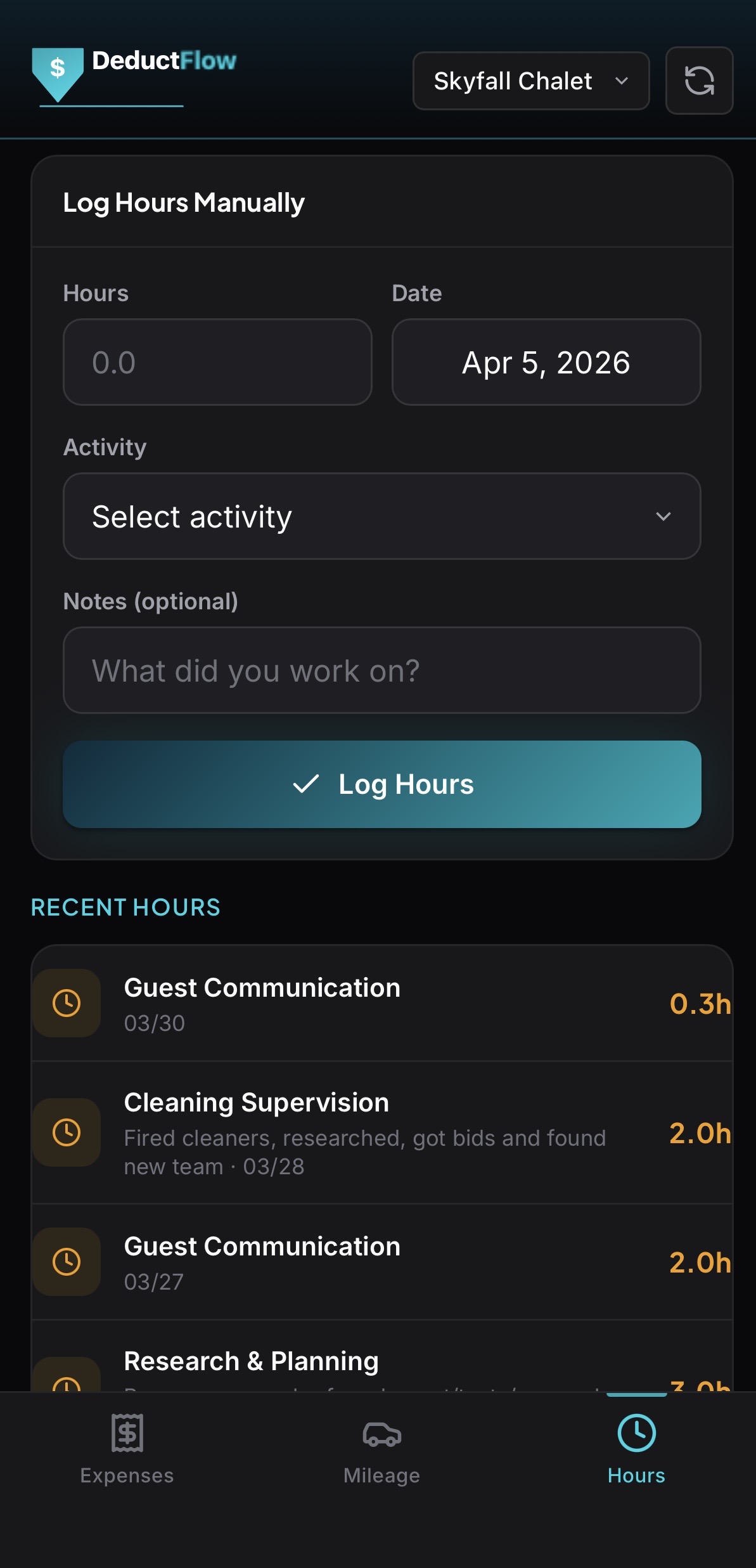
Every requirement of the short-term rental tax loophole comes down to documentation, and that is exactly what DeductFlow is built for. The app keeps a contemporaneous, time-stamped log of your active hours as you work them, so your 100+ hours are recorded the way the IRS expects instead of reconstructed in April. It captures your receipts, expenses, and mileage through the year, and stores your cost segregation study alongside them. At tax time you hand your CPA one complete file: the hours log, the records, and the documentation that supports non-passive treatment. In an audit, the log is the deduction.
Start a free 7-day trial and have the log running before your next guest checks in.
For a full breakdown of all seven tests and which activities count toward your hours, see our complete material participation guide, the dedicated post on the 100-hour rule explained, and our comparison of the 500-hour safe harbor vs the 100-hour test.
Short-Term Rental Tax Loophole: $40,000 Tax Savings Example
Let's put concrete numbers to the short-term rental tax loophole. Here's a realistic scenario for a high-income W-2 earner who purchases an STR property:
Year 1 STR Tax Scenario
| Property purchase price | $600,000 |
| Cost segregation study identifies 5-year property | $150,000 |
| Bonus depreciation (100% in 2026) | $150,000 |
| Gross rental income | $80,000 |
| Operating expenses (supplies, utilities, platform fees, etc.) | ($40,000) |
| Total depreciation (bonus $150K + remaining building ~$16K at 27.5 yrs) | ($166,000) |
| Net STR paper loss | ($126,000) |
| W-2 income (before STR offset) | $200,000 |
| Adjusted gross income (after STR loss) | $74,000 |
| Marginal tax rate | 32% |
| Year 1 tax savings | ~$40,000 |
A few important notes on this scenario:
- The $150,000 depreciation figure assumes cost segregation identifies $150,000 in 5-year personal property. In 2026, 100% bonus depreciation applies to that pool under the One Big Beautiful Bill Act, yielding $150,000 in immediate deductions, plus approximately $16,000 in regular depreciation on the remaining building portion over 27.5 years. If your CPA uses the 39-year schedule, as many do for STRs rented mostly to short-stay guests, that figure is about $11,500, the loss about $121,500, and the year-one savings about $39,000.
- The actual depreciation available depends on the specific property, its contents, and the cost segregation analysis. Results vary.
- This is a paper loss. The property may be cash-flow positive. The owner isn't losing money. They are reducing taxes through accelerated deductions that will eventually be recaptured (depreciation recapture) when the property is sold.
- To claim this $126,000 loss against W-2 income, the owner must have passed the material participation test. Without it: zero benefit in year 1.
Step-by-Step: How to Use the Short-Term Rental Tax Loophole
Here is the implementation path, in order:
Step 1: Purchase or Designate an STR Property with Average Stays Under 7 Days
Your property must generate average bookings of 7 nights or fewer. Most Airbnb, VRBO, and short-term rental properties with 2 to 7 night minimum stays will naturally qualify. Review your booking data to confirm average stay length before year-end.
Step 2: Confirm Filing Treatment with Your CPA
STRs with material participation are typically reported as an active STR business on your CPA's recommended form, not as passive rental income. This is a meaningful distinction, because active business treatment is what allows the non-passive loss offset. Confirm with your CPA that your situation supports this filing treatment. Not all CPAs are familiar with the short-term rental tax loophole; find one with STR-specific experience.
Step 3: Commission a Cost Segregation Study
Hire a qualified cost segregation firm (typically engineers or specialized CPAs) to analyze your property and reclassify components. A study on a $500K to $1M property typically costs $3,000 to $8,000. The tax savings in year one almost always exceed the study cost by a wide margin. Time the study for your first tax year of ownership to maximize year-one deductions. If you book through our cost segregation page, your first study is 10% off, applied automatically at proposal.
Step 4: Track Material Participation Hours Throughout the Year
This is where most investors fail. You must log qualifying activities contemporaneously, as they happen, including the date, duration, and description of each activity. Qualifying activities include:
- Guest communication (messaging, reviewing inquiries, check-in coordination)
- Cleaning coordination and quality review
- Maintenance management and contractor oversight
- Supply runs and restocking
- Listing management and pricing optimization
- Bookkeeping and financial review
- Marketing and photography
- Regulatory work (permits, local taxes)
You need 100+ hours, and no other individual can log more hours than you. See our active hours tracker for a tool built specifically for this purpose.
Step 5: Maintain a Contemporaneous Log
A contemporaneous log means records created at or near the time of the activity, not reconstructed from memory at year-end. The IRS specifically scrutinizes reconstructed logs. Your log should include:
- Date of activity
- Activity description
- Time spent (start/end or duration)
- Property reference (if you own multiple STRs)
Digital logs with timestamps are more defensible than handwritten notebooks. See our guide on building an IRS-compliant contemporaneous log.
Step 6: Provide Complete Records to Your CPA at Tax Time
Your CPA needs your hours log, your cost segregation report, your STR income/expense records, and your average stay calculation. With complete documentation, your CPA can accurately apply the non-passive loss to your 1040.
How the IRS Audits the Short-Term Rental Tax Loophole
Most STR investors who pursue the short-term rental tax loophole do steps 1 through 3 reasonably well. They find a property, connect with a CPA, and commission a cost segregation study. The math looks great on paper.
Then December arrives and they realize they never tracked their hours.
They try to reconstruct a log from memory, calendar entries, text messages, and Airbnb inbox timestamps. They cobble together something that adds up to 105 hours and hand it to their CPA.
This is the single most common reason material participation claims are disallowed in IRS audits. The IRS does not accept reconstructed logs as contemporaneous records. Revenue Procedure 2001-18 and longstanding case law make clear that logs created at year-end without contemporaneous support are suspect.
An auditor will ask: where are the entries from January? Why are all your entries in November and December? Can you produce any corroborating evidence, such as Airbnb messages, contractor receipts, and calendar entries, that match the dates in this log?
If you can't answer those questions with evidence, the material participation claim fails. The $126,000 loss becomes passive. The $40,000 tax savings disappears, and you may owe penalties and interest on top.
The documentation gap is not a tax problem. It's a habit problem. Solving it requires tracking in real time, consistently, throughout the year. That's precisely what DeductFlow's active hours tracker is designed to do.
Is the Short-Term Rental Tax Loophole Legal?
Yes. Unambiguously.
The short-term rental tax loophole is a statutory provision under IRC Section 469(c)(2), written into the Internal Revenue Code by Congress. It is not a gray area, an aggressive position, or a workaround. It is the law as written. Thousands of STR investors use it legitimately every year with proper documentation and qualified CPA support.
That said, "legal" does not mean "automatically granted." The IRS can, and does, audit material participation claims. The legal validity of the short-term rental tax loophole is not in question; the factual question (did you actually materially participate, and can you prove it?) is what gets tested.
Some important guardrails:
- You must genuinely participate. You cannot simply claim 101 hours without actually performing qualifying work. The hours you log must reflect real activities you actually did.
- Your CPA must agree on the filing treatment. Not all STR situations support active business treatment. Your CPA determines the appropriate filing approach for your specific facts.
- Depreciation recapture applies at sale. The deductions you take now are not free money. They reduce your basis in the property. When you sell, the IRS recaptures those deductions at a 25% rate (unrecaptured Section 1250 gain). A complete tax plan accounts for this.
2026 Tax Law Update: 100% Bonus Depreciation Restored
The most significant change affecting the short-term rental tax loophole in 2026 is the restoration of 100% bonus depreciation under the One Big Beautiful Bill Act (OBBBA):
- 2022: 100% bonus depreciation
- 2023: 80% bonus depreciation (TCJA phase-down)
- 2024: 60% bonus depreciation (TCJA phase-down)
- 2025: 40% bonus depreciation (TCJA schedule), then OBBBA passed
- 2026: 100% bonus depreciation restored by the One Big Beautiful Bill Act and made permanent for property acquired after January 19, 2025
Verify current bonus depreciation rates with your CPA, as tax legislation can change. The key point: with 100% bonus depreciation fully restored, the short-term rental tax loophole delivers its maximum year-one tax benefit in 2026.
On the STR classification rules themselves, there have been no material changes to IRC Section 469(c)(2) or the material participation regulations. The core strategy remains intact. What has shifted is increased IRS scrutiny of material participation claims in the STR context, making documentation more important than ever.
Frequently Asked Questions
What is the short-term rental tax loophole?
The short-term rental tax loophole refers to IRC Section 469(c)(2), which excludes short-term rentals (average guest stay of 7 days or fewer) from the passive activity loss rules that normally limit rental deductions. When the owner materially participates, losses from the STR, including accelerated depreciation from a cost segregation study, can offset ordinary income like W-2 wages. CPAs call it the material participation strategy.
How much can the short-term rental tax loophole save in taxes?
Savings depend on the property value, cost segregation results, and the owner's marginal tax rate. In a typical example, a W-2 earner with $200,000 in wages who buys a $600,000 STR and applies a cost segregation study with 100% bonus depreciation could generate roughly $126,000 in paper losses, reducing taxable income to approximately $74,000 and saving around $40,000 in federal taxes in year one.
Does the short-term rental tax loophole work for W-2 employees?
Yes. The short-term rental tax loophole is especially valuable for W-2 employees because it allows non-passive rental losses to offset wage income. If you file a joint return, the loss can also offset your spouse's W-2 income. The key requirement is that the owner must materially participate in the rental activity, logging 100 or more hours where no other individual logs more.
What are the IRS requirements for the short-term rental tax loophole?
Three requirements must be met: (1) the average guest stay must be 7 days or fewer, (2) the owner must materially participate in the rental activity, typically by logging more than 100 hours with no other individual logging more, and (3) a cost segregation study should be used to accelerate depreciation and create a meaningful paper loss. Contemporaneous time logs are essential for audit defense. See our 100-hour rule explained post for a full breakdown.
Can I use the short-term rental tax loophole without a cost segregation study?
Technically yes, but the tax benefit is dramatically smaller. Without cost segregation, annual depreciation on a $600K property is roughly $15,000 to $20,000. A cost segregation study can front-load $150,000 or more in year-one depreciation using 100% bonus depreciation, creating a much larger paper loss to offset income. The short-term rental tax loophole is far less powerful without it. Read our guide on building an IRS-compliant contemporaneous log.